
University of Illinois Urbana-Champaign
Hi! I'm a final-year Ph.D. candidate in Computer Engineering at the University of Illinois Urbana-Champaign (UIUC), advised by Prof. Volodymyr Kindratenko. Before that, I received my M.S. from UIUC, advised by Prof. Shenlong Wang, where I worked on generative models for autonomous driving, and my bachelor's degrees from the ZJU-UIUC Institute.
My research centers on large language and vision-language models, in particular reinforcement learning–based post-training and AI agents. I also have substantial experience with visual generative models such as diffusion and video generation. Across these areas, I am especially interested in turning imperfect feedback, such as online user signals, LLM judgments, and visual quality metrics, into reliable training rewards for open-ended tasks. My work spans applications in e-commerce search, web automation, medical report generation, and video creation, as well as generative models for autonomous driving earlier in my PhD. I regularly serve as a reviewer for CVPR, ECCV, and NeurIPS.
I am graduating in December 2026 and looking for full-time Research Scientist/Engineer and Machine Learning Engineer positions in VLMs, AI agents, and video generation. Feel free to reach out!
Education
-
 University of Illinois Urbana-ChampaignPh.D. in Computer EngineeringAug. 2021 - Dec. 2026 (expected)Advisor: Prof. Volodymyr Kindratenko
 -
University of Illinois Urbana-ChampaignM.S. in Computer EngineeringAug. 2021 - May 2023Advisor: Prof. Shenlong Wang
-
 Zhejiang University & UIUC (ZJU-UIUC Institute)B.Eng. (ZJU) & B.Sc. (UIUC) in Computer Engineering, dual-degree programAug. 2017 - May 2021
Experience
-
 TikTokMachine Learning Engineer InternMay 2026 - Aug. 2026
 -
 Xpeng MotorsMachine Learning InternMay 2025 - Jan. 2026
 -
 AmazonApplied Scientist InternMay 2024 - Aug. 2024
Experience & Projects
Filter by topic: All 8 LLM / VLM 5 AI agent 4 Autonomous driving 3 AI for healthcare 2 Diffusion models / visual generative models 4 Video generation / understanding 2Industry
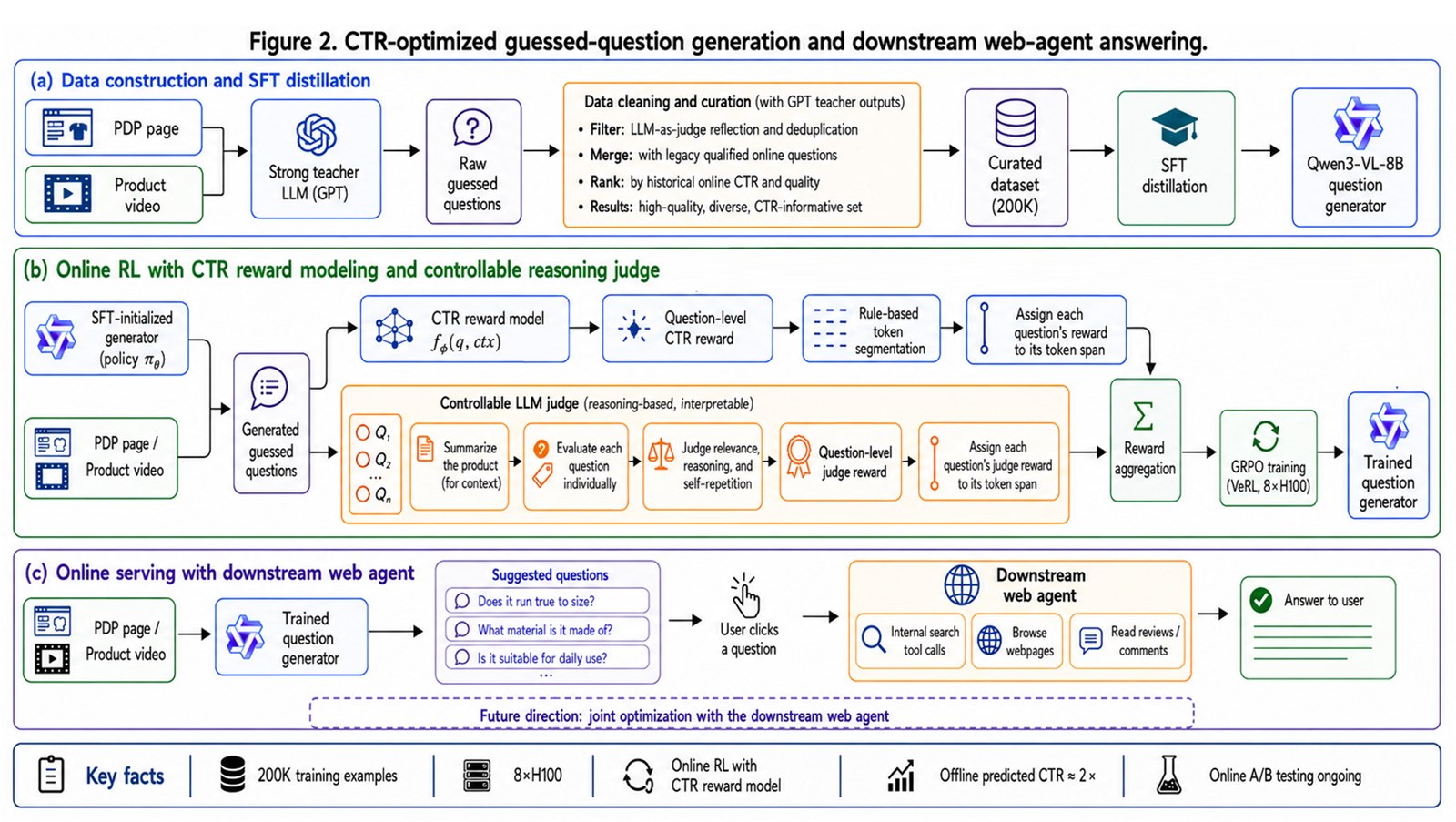
Query recommendation and agentic search for e-commerce product pages and videos
TikTok · Machine Learning Engineer Intern · May – Aug 2026
LLM / VLM AI agent RL post-training Reward design Distributed training E-commerce Query recommendation
Schematic of the serving and training pipeline. Internal work; no public paper.
- Post-trained Qwen3-VL-8B for query recommendation: distillation from a frontier closed-source model on 200K samples, then GRPO with rewards from the online CTR of deployed questions and an agent-as-judge.
- A downstream web agent answers the proposed questions by tool-calling internal search.
- Trained with verl. Doubled offline-estimated CTR over the production system.
Internal project — no public release
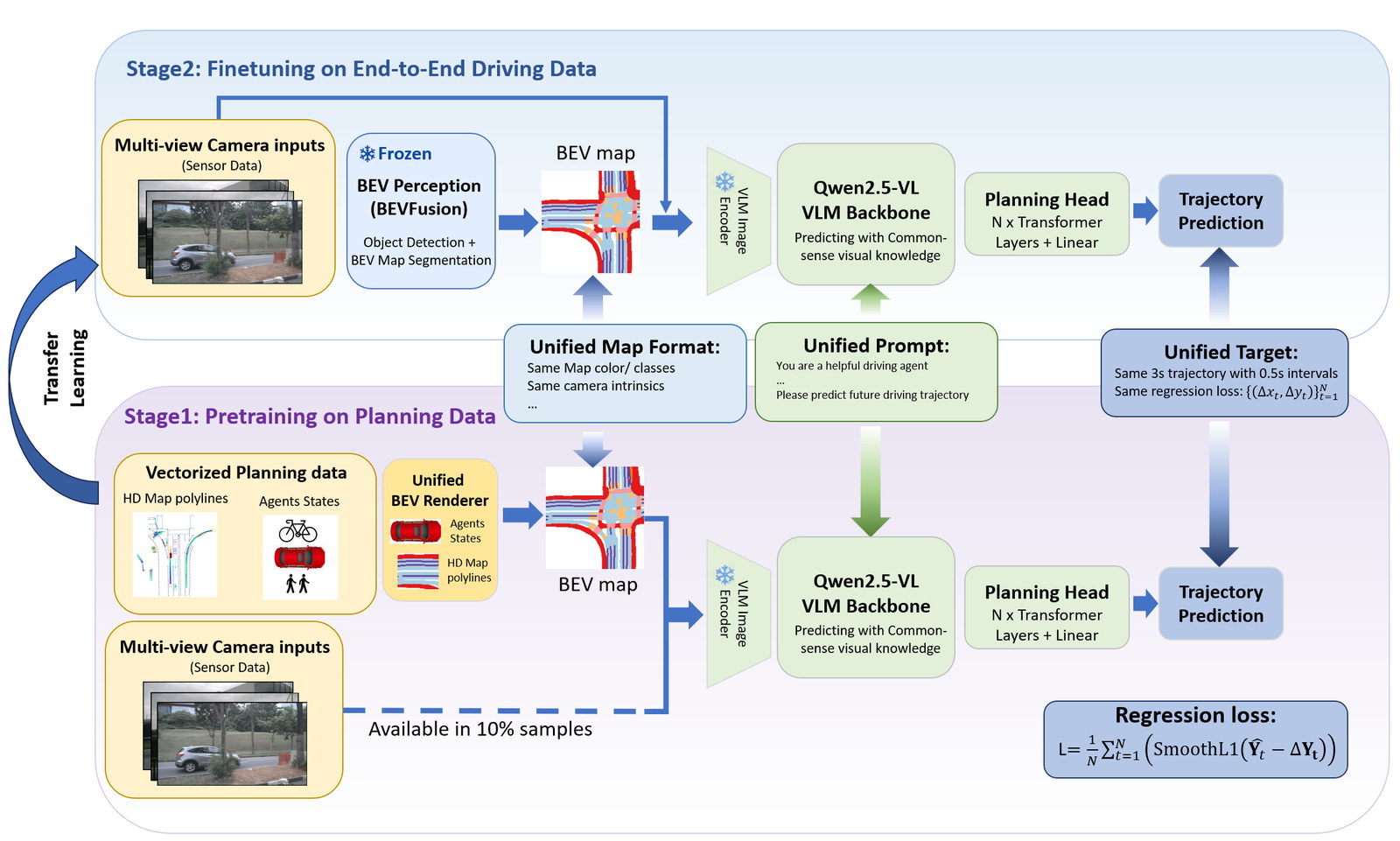
TransDrive: a shared-BEV vision–language–action framework unifying planning and end-to-end driving
Xpeng Motors · Machine Learning Intern · May 2025 – Jan 2026
LLM / VLM Autonomous driving Vision-language-action BEV representation End-to-end driving Distributed training
Two-stage training: pretrain on rendered nuPlan planning data, then fine-tune on nuScenes with BEV maps from a frozen perception model.
- Instead of feeding a VLM latent BEV embeddings, render perception outputs and vectorized planning data into the same human-readable BEV image, so one Qwen2.5-VL backbone serves both tasks without architectural changes.
- The shared representation unlocks pretraining on planning datasets that are 10× larger than end-to-end driving data, then transfer to sensor-based driving — with the largest gains in low-data regimes.
- Led distributed training on 200+ GPUs; reduced L2 trajectory error by 4–9% over the baseline model.
Manuscript under review
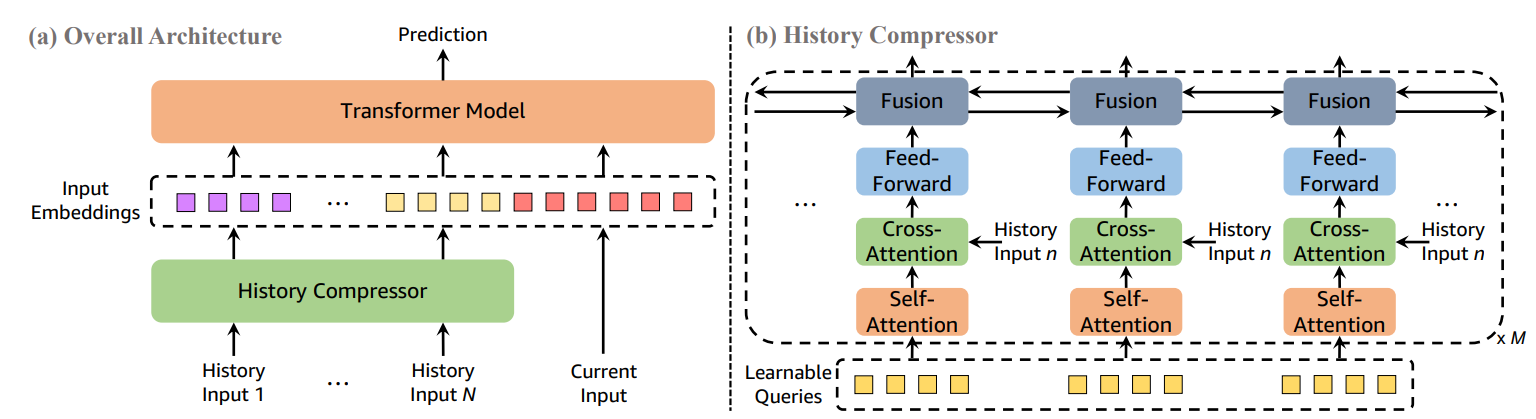
Turbocharging Web Automation: The Impact of Compressed History States ACL 2025 Findings
Amazon · Applied Scientist Intern · May – Aug 2024
LLM / VLM AI agent Web agents Context compression
A shared history compressor distills each verbose past web state into a fixed-length representation before the action-prediction transformer.
- Designed a compressed history-state representation for VLM web agents, cutting context length by ~70% while preserving the action history needed for multi-step navigation.
- Improved step accuracy by 2–5% on Mind2Web and WebLINX.
Research
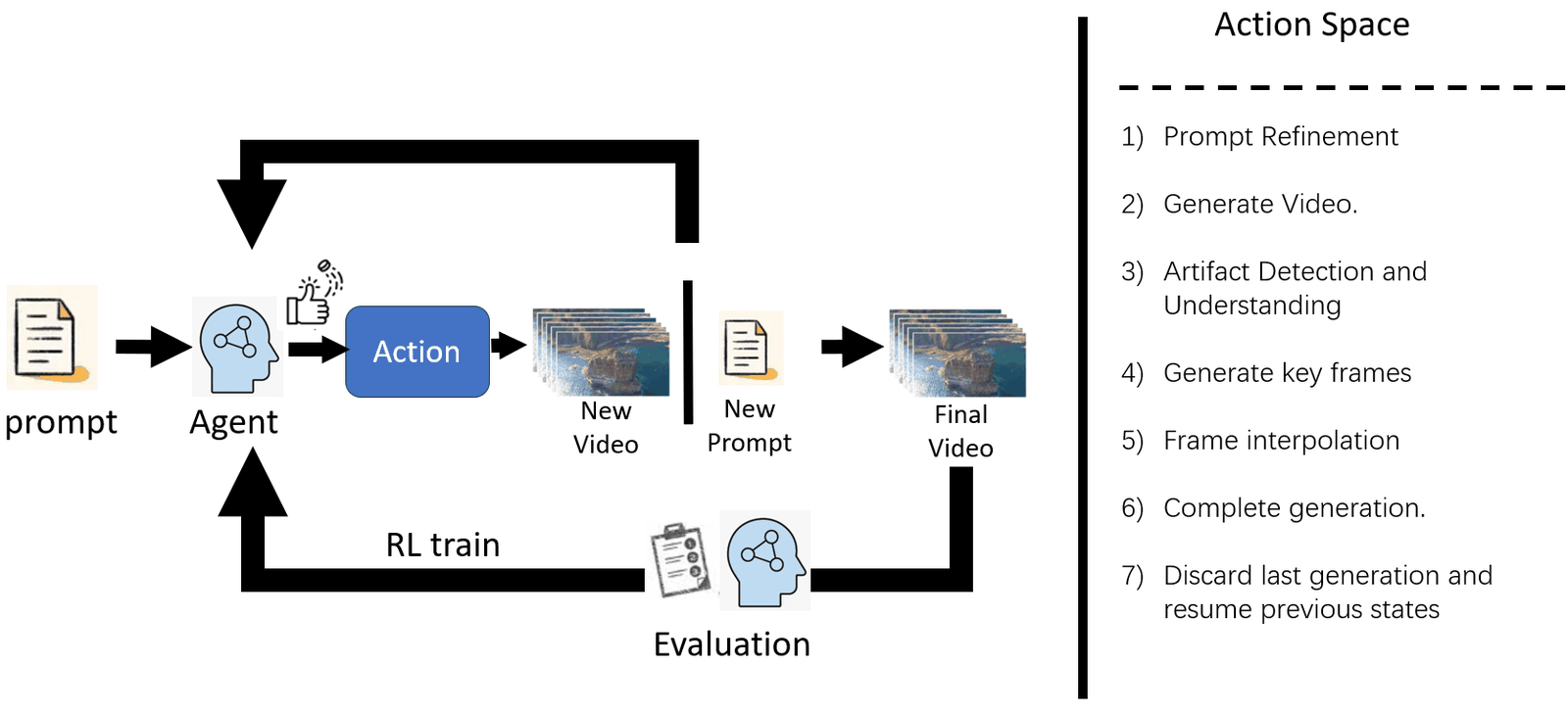
Agentic reasoning for video generation
UIUC · Dissertation chapter · Jan 2025 – Jun 2026
Video generation / understanding AI agent LLM / VLM Diffusion models / visual generative models RL post-training Reward design Chain-of-thought planning
The generator and its metrics are treated as an environment; language agents plan, inspect, regenerate, and roll back around a frozen video diffusion model.
- A video-creation agent that integrates chain-of-thought planning and iterative self-refinement into video generation, built on Causal Forcing as the generator and Qwen2.5-VL-7B as the reasoner.
- Four roles around a frozen generator: a prompt agent, a video-understanding agent with adaptive frame inspection, a keyframe agent for hard temporal transitions, and a supervisor that can roll back to a better earlier candidate.
- Trained the reasoner with GRPO using VisionReward on the final video (minus a diffusion-call penalty) as the reward, improving VisionReward by 20.3% over the base generator with better physical plausibility and causal consistency.
- Supports multi-modal conditioned generation and interactive, interpretable editing through explicit reasoning traces.
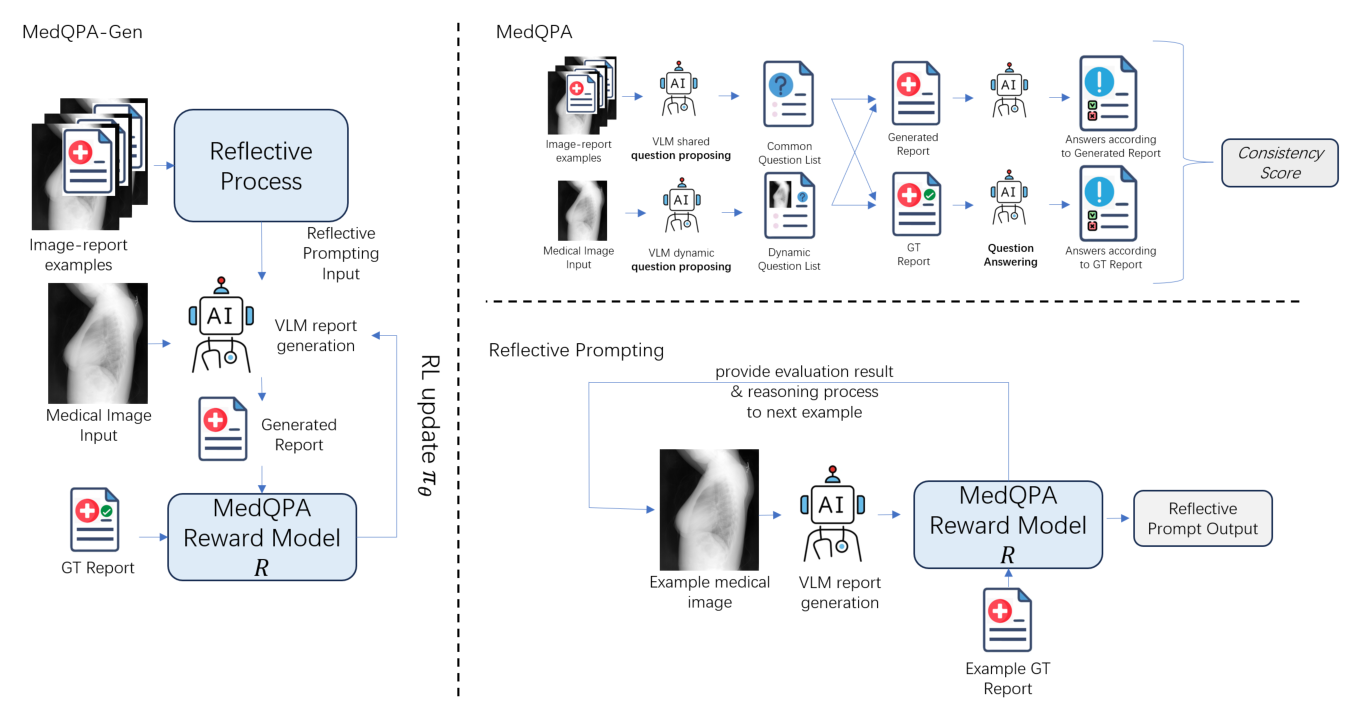
MedQPA-Gen: Medical Question Proposing and Answering for Report Generation ACL 2026 Findings
UIUC · Jun 2025 – Jan 2026
AI for healthcare LLM / VLM AI agent RL post-training Reward design Report generation LLM-as-judge
Figure 2 of the paper: the MedQPA evaluation loop (question proposing and answering), reflective prompting, and the RL update against the MedQPA reward model.
- Proposed MedQPA, a question-driven agentic evaluation pipeline for medical report generation: propose clinical questions, answer them against image and report, and score fact consistency.
- Developed MedQPA-Gen, which optimizes report generators against MedQPA via reflective prompting, iterative DPO, and GRPO on Qwen2-VL-7B.
- 80% human-preference win rate over the base model and +3.5% accuracy on downstream disease classification.
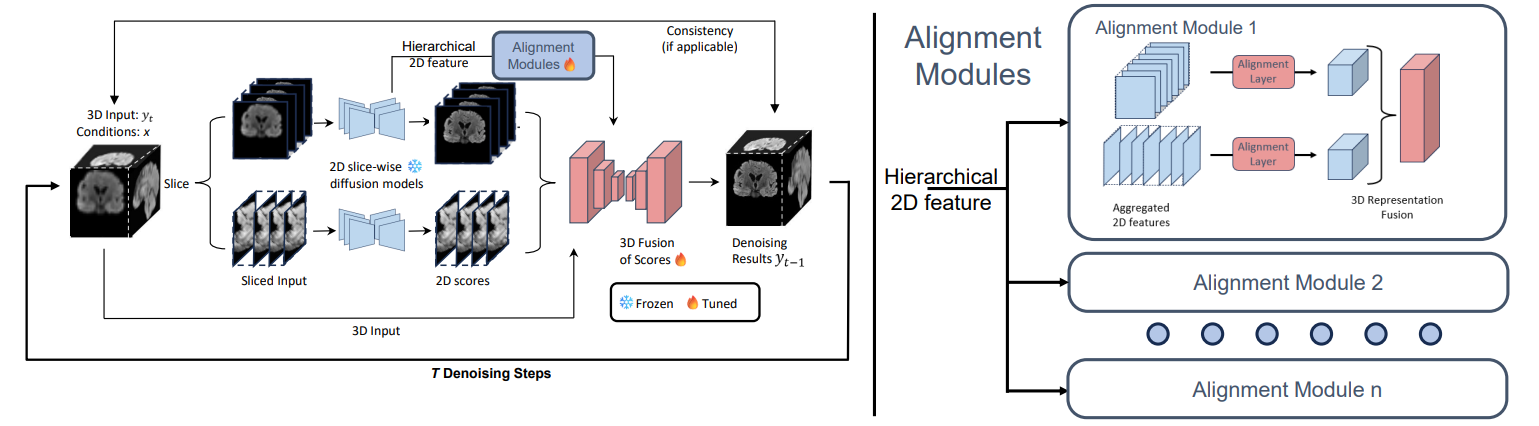
Introducing 3D Representation for Volume-to-Volume Translation via Score Fusion ICML 2025
UIUC · Nov 2023 – Feb 2025
Diffusion models / visual generative models AI for healthcare Video generation / understanding MRI super-resolution Inverse problems 3D representation
At each denoising step, perpendicularly trained 2D diffusion models give initial estimates and a lightweight 3D network learns to fuse them in score space; alignment modules inject hierarchical 2D features.
- Score Fusion learns to fuse diffusion score functions instead of combining them arithmetically, yielding a 3D representation for volume-to-volume translation and multi-modal fusion — the first work to bring 3D generative priors into MRI super-resolution and outperform 2D methods.
- Improved 3D medical-image and video inverse-problem results by 3–10%, with better downstream tumor segmentation.
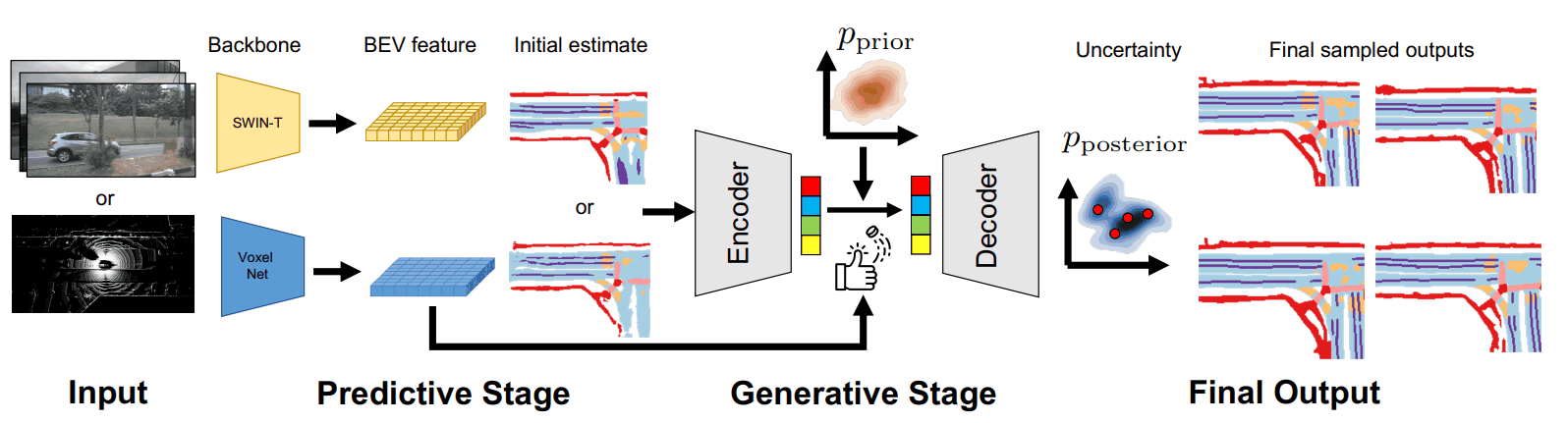
MapPrior: Bird's-Eye View Map Layout Estimation with Generative Models ICCV 2023
UIUC · Jul 2022 – Aug 2023
Autonomous driving Diffusion models / visual generative models BEV map segmentation Generative priors
An off-the-shelf perception model gives a noisy estimate; a generative encoder, transformer sampler, and decoder turn it into realistic, diverse map layouts.
- Introduced generative priors for BEV map segmentation, exploiting the prior distribution of map layouts to fix occluded and out-of-range regions.
- Improved IoU by ~1% and substantially improved realism (MMD) and uncertainty estimation (ECE) for downstream planning on nuScenes.
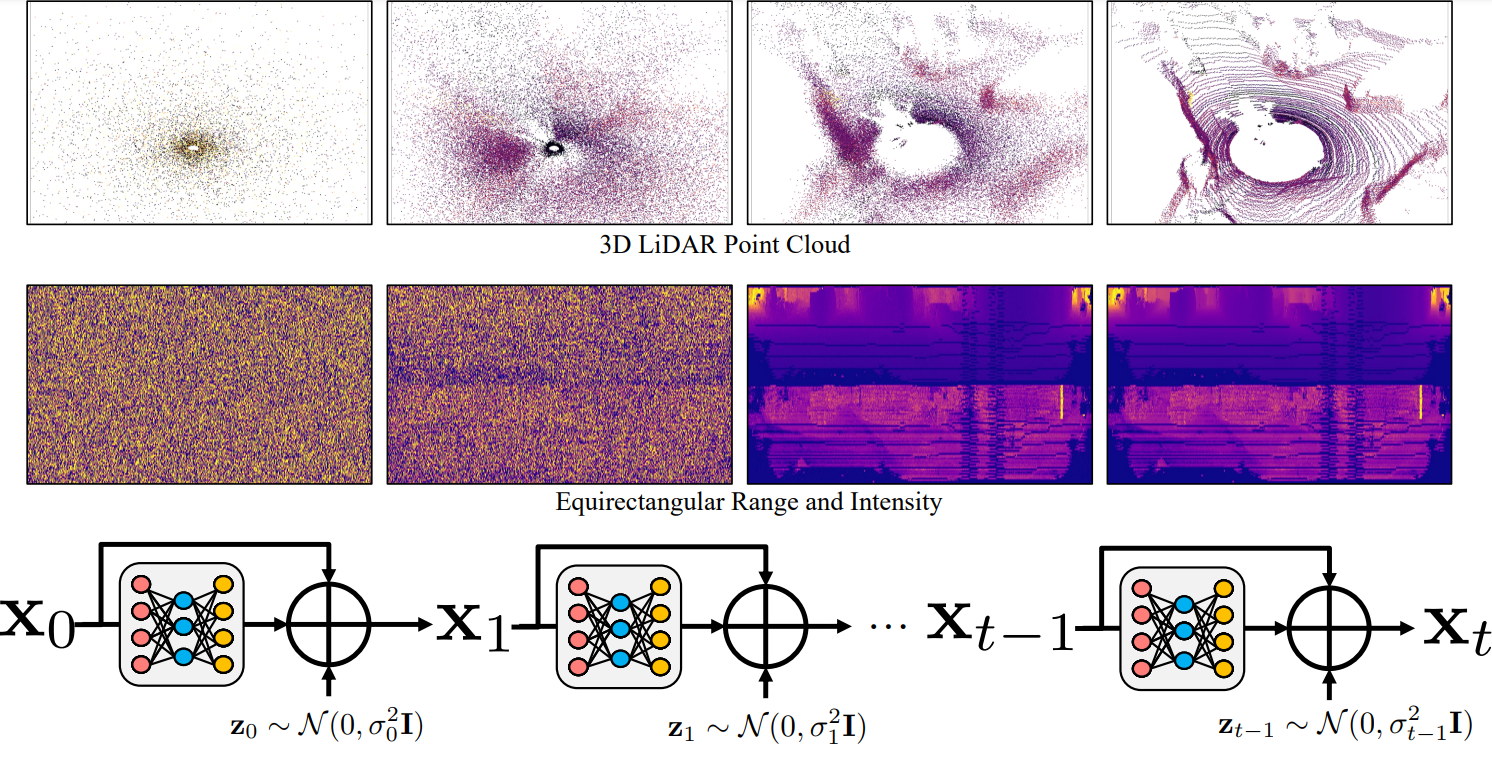
LiDARGen: Learning to Generate Realistic LiDAR Point Clouds ECCV 2022
UIUC · Jan – Oct 2022
Autonomous driving Diffusion models / visual generative models LiDAR generation Score-based models
Point clouds are generated by score-based denoising in the equirectangular range/intensity view.
- Implemented BEV-FID metrics and LiDAR generative baselines (ShapeGF, PU-GAN) for evaluating the realism of generated LiDAR scans on KITTI-360 and nuScenes.